
Education News
Trump’s Executive Order to Eliminate the Department of Education Sparks Nationwide Concern
MARCH 21, 2025
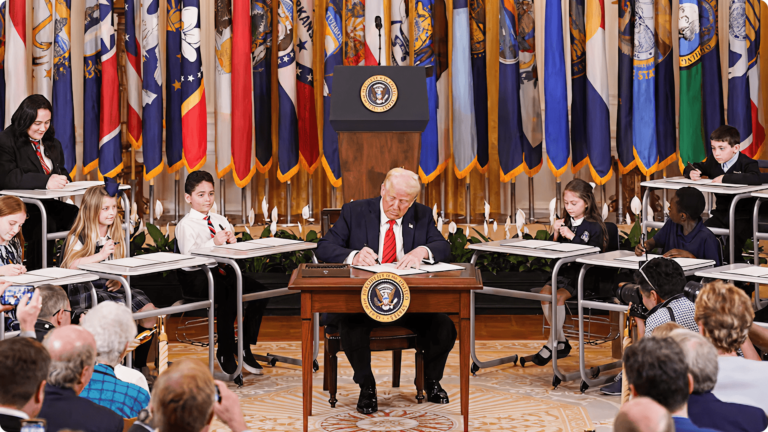
Photo Credit: Nathan Howard/Reuters
In a sweeping and controversial move, President Donald Trump signed an executive order on March 20th, 2025, that begins the process of dismantling the U.S. Department of Education. Long a target of conservative critics who argue for state and local control over schools, this executive action could radically shift the educational landscape in America—and not for the better, say experts and education advocates.
What’s at Stake?
The Department of Education, established in 1979, has played a vital role in promoting equal access to quality education, distributing billions in federal funding, enforcing civil rights, and collecting critical data on student performance and school accountability.
Eliminating it may sound like a win for smaller government, but the consequences for schools—especially those in low-income and underserved communities—could be devastating.
“Each year, the Department of Education distributes over $79 billion in discretionary funding. Without federal oversight, there’s no guarantee that states would maintain these funding levels or distribute them equitably.”
1. Disruption in Federal Funding
Each year, the Department of Education distributes over $79 billion in discretionary funding. Title I, one of the largest programs, allocates around $18 billion to schools serving high-poverty communities. Without federal oversight, there’s no guarantee that states would maintain these funding levels or distribute them equitably.
• Fact: In 2023, over 56,000 schools relied on Title I funding to support disadvantaged students.
• Impact: Many of these schools could see cuts, threatening tutoring, after-school programs, and even basic classroom resources
2. Civil Rights Protections in Jeopardy
The Department’s Office for Civil Rights handled over 15,000 complaints in 2022 alone, addressing issues from racial discrimination to the rights of students with disabilities.
Removing this federal oversight risks leaving vulnerable populations and those with disabilities—without a clear channel for protection or accountability.
• Impact: The legal burden may fall to states, many of which have inconsistent or limited enforcement policies.
“The Department’s Office for Civil Rights handled over 15,000 complaints in 2022 alone, addressing issues from racial discrimination to the rights of students with disabilities.”
3. Special Education at Risk
Roughly 7.5 million students, or 15% of all public school students, receive special education services under the Individuals with Disabilities Education Act (IDEA), a federal law.
• Without federal enforcement, states may interpret or implement IDEA differently, potentially reducing services or increasing the burden on families to advocate for their children’s needs.
“The ‘Nation’s Report Card’ (NAEP) provides benchmarks on student achievement. In 2023, only 33% of fourth graders were proficient in reading.”
4. Data, Research, and National Standards Could Collapse
The department’s National Center for Education Statistics and other bodies collect key data used to drive evidence-based education policy. If dissolved, this data collection could become fragmented, or stop altogether.
• Fact: The “Nation’s Report Card” (NAEP) provides benchmarks on student achievement. In 2023, only 33% of fourth graders were proficient in reading. Without data like this, policymakers would be flying blind.
5. National Cohesion Could Fracture
Federal education policy helps ensure a baseline of quality and equity. Without it, the U.S. risks becoming 50 different education systems, with wide disparities in curriculum standards, teacher qualifications, and student outcomes.
• Warning Sign: As of 2024, the top-performing states in education (like Massachusetts) already spend over $16,000 per student, while the lowest (like Idaho) spend under $8,000. Removing federal oversight could widen this gap further.
Final Thoughts
While proponents argue that dismantling the Department of Education empowers local communities and reduces bureaucracy, critics see it as a reckless gamble with America’s future.
“The Department of Education has played a crucial role in leveling the playing field for millions of students,” said Lily Eskelsen García, former NEA president. “Without it, we risk returning to a time when educational opportunity was determined by zip code, income, and race.”
“What happens when there’s no one left to protect our children’s right to learn?”
As the nation waits to see how this executive order unfolds, school leaders, parents, and educators are left grappling with a difficult question: What happens when there’s no one left to protect our children’s right to learn?